
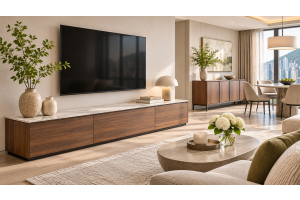
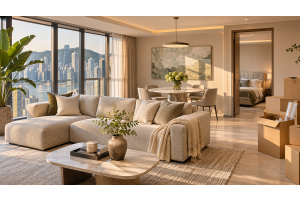


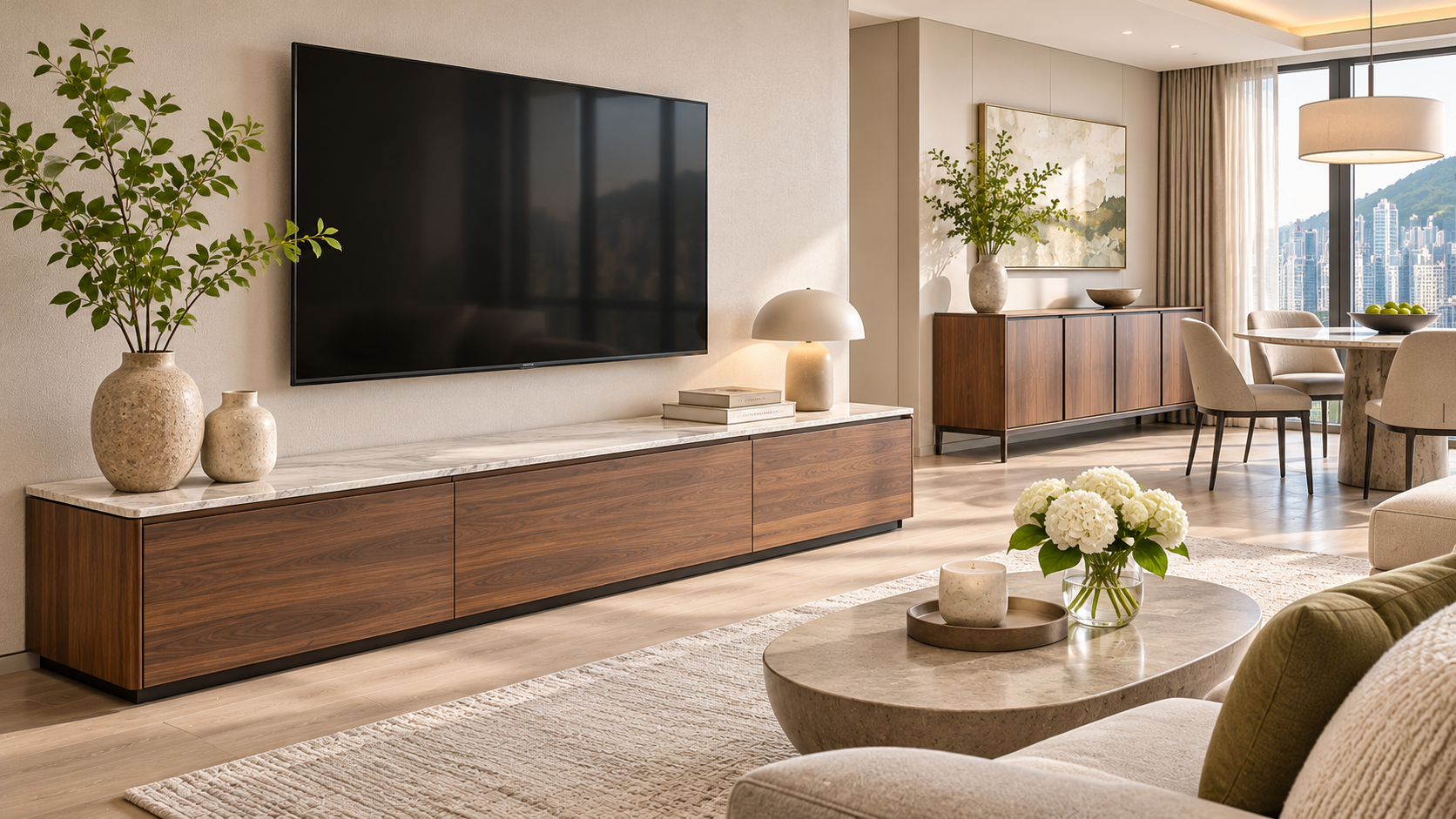
In most Hong Kong living rooms, the TV wall is the one stretch of wall without a window, a door or an air conditioner on it. That makes the TV unit, and the sideboard that often sits beside the dining table, the main storage in the room. Choose well and they hide the router, the cables, the board games and the takeaway menus. Choose badly and they eat into the walkway, look too small for the screen, or leave you with clutter on every surface.
After more than 20 years of furnishing Hong Kong apartments, here is how we help clients choose and size a TV unit and sideboard that actually work.
Quick answer: Choose a TV unit 30 to 50cm wider than your screen and around 40 to 45cm deep. Keep the centre of the screen roughly at eye level when seated, which usually means a unit 40 to 55cm high. Mix closed storage for clutter with a little open shelving for display, and leave at least 90cm between a sideboard and the dining table so chairs can move freely.
Start with the Wall, Not the Catalogue
Before you look at designs, measure the wall the unit will sit against. Note the total width, the positions of sockets, cable outlets and the aerial or fibre point, and anything that limits the space such as a window frame, a column, a beam or a split type air conditioner above. In older Hong Kong buildings the TV point is often off centre, so plan whether the screen will sit in the middle of the wall or in the middle of the unit.
Then measure the room in front of it. You need a clear walkway of at least 75 to 90cm between the unit and the coffee table or sofa. This is the single most common reason a TV unit feels too big in a compact flat.
How Wide Should a TV Unit Be?
The unit should be wider than the TV. A good rule is 30 to 50cm wider than the screen, so the TV sits comfortably with space either side for a speaker, a plant or a lamp. As a guide:
| TV size | Approx. screen width | Suggested unit width |
|---|---|---|
| 50 inch | 112cm | 150 to 160cm |
| 55 inch | 122cm | 160 to 180cm |
| 65 inch | 145cm | 180 to 200cm |
| 75 inch | 167cm | 200 to 220cm |
If your wall is narrow, a unit only slightly wider than the screen can still work, especially if the TV is wall mounted above it rather than standing on top.
Height and Depth
For comfortable viewing from the sofa, the centre of the screen should sit roughly at eye level when you are seated, about 100 to 110cm from the floor for most people. With a TV on a stand, that usually means a unit between 40 and 55cm high. If you wall mount the TV, the unit can be lower and longer, which makes the room feel wider.
Depth is where small flats gain or lose space. Around 40 to 45cm holds most TV stands, soundbars and set top boxes. Go deeper only if you need to store larger items, and check the depth against your walkway before you commit.
Storage: Closed, Open or Both?
The best TV units combine both. Closed drawers and doors hide the clutter: remote controls, chargers, games, paperwork and the router. A small amount of open shelving gives you space for books, a plant or a favourite object, and keeps the unit from looking like a solid block.
A few practical details make a big difference:
- Cable management: ask for cut outs or a removable back panel so cables run out of sight
- Ventilation: routers and games consoles need airflow, so leave an open or perforated section for them
- Remote friendly doors: glass or slatted fronts let infrared signals reach a set top box behind a closed door
- Soft close drawers: worth having in a unit you open several times a day
Floating or Floor Standing?
A wall hung, floating TV unit shows more floor, which makes a small living room feel larger and makes cleaning easier. It does need a solid wall and careful installation, so check whether your wall is concrete or a lightweight partition first. A floor standing unit is simpler, holds more weight and can move with you if you rearrange the room or the flat. Units on slim metal legs offer a middle ground, lifting the body off the floor without fixing anything to the wall.
Where the Sideboard Fits In
In many Hong Kong flats the living and dining areas share one room, and the sideboard is what makes the dining side work. It keeps plates, glasses, table linen and serving dishes within reach of the table, and gives you a surface for serving, a lamp or a piece of art.
The key measurement is clearance. Leave at least 90cm between the sideboard and the edge of the dining table so chairs can be pulled out and people can walk behind them. That is why depth matters even more here: a 40cm deep sideboard is usually the sweet spot, and a slim 35cm cabinet is a good option where space is tight.
In smaller open plan flats, one long, low sideboard can do both jobs, holding the TV at one end and tableware at the other. It is a neat way to get more storage from a single piece of furniture.
Choosing Materials and Finishes
Because the TV unit and sideboard are large, their finish has a big influence on the feel of the room.
- Walnut and oak: warm and natural, and easy to match with wooden floors and dining tables
- Marble and sintered stone tops: add a sense of luxury and are hard wearing, with sintered stone the easier of the two to look after
- Lacquer: a clean, modern look in white, grey or a bold colour, ideal for minimalist rooms
- Metal and glass details: brass, bronze or black metal legs and glass doors keep a large piece looking light
If you are choosing both pieces, match them, or at least repeat one material. A walnut TV unit with a walnut and marble sideboard ties an open plan room together. Our furniture care guide covers how each finish holds up in Hong Kong's humidity.
Common Mistakes to Avoid
- Buying a unit narrower than the TV: it looks unbalanced and the screen is easier to knock over
- Forgetting the walkway: a deep unit in a narrow room makes the whole space feel cramped
- No plan for cables: without cut outs or a back panel, wires end up draped down the front
- All open shelving: it looks good in photos but quickly fills with clutter in daily life
- Mismatched pieces: a TV unit and sideboard in unrelated finishes make an open plan room feel busy
Why Made to Order Makes Sense Here
TV walls in Hong Kong are rarely a standard width. A unit made to order can fill the wall between a window and a corner exactly, step around a column, or sit under an air conditioner without blocking airflow. You choose the length, height and depth, the finish, and the mix of drawers, doors and shelves, so the piece fits both the wall and what you actually need to store. Most of our pieces are ready in about 6 weeks.
Browse our TV units and sideboards and cabinets, see how they pair with our coffee tables and sofas, or read our guide to furnishing a new home in Hong Kong. If you are starting from scratch, our custom furniture service can plan the whole living and dining area.
Frequently Asked Questions
How wide should a TV unit be?
Ideally 30 to 50cm wider than your TV screen, so the screen does not look as if it is about to fall off the ends. For a 65 inch TV, which is about 145cm wide, a TV unit of 180 to 200cm usually looks balanced.
What depth of TV unit or sideboard suits a small Hong Kong flat?
Around 40 to 45cm deep works for most TV units and sideboards. In a narrow entrance or corridor, a slim 30 to 35cm cabinet keeps the walkway clear while still giving useful storage.
Should I choose a floating or floor standing TV unit?
A wall hung, floating unit makes a small room feel larger and is easier to clean under, but it needs a solid wall and careful installation. A floor standing unit is simpler, holds more weight and can be moved if you change your layout.
Can a sideboard double as a TV unit?
Yes. A low sideboard of around 60 to 75cm high works well as a TV unit, especially in open plan flats where one piece needs to serve both the living and dining areas. Check there is space at the back for cables.
Can DSL make a TV unit or sideboard to fit my wall?
Yes. Every piece is made to order, so the length, height, depth, finish and mix of drawers, doors and shelves can all be tailored to your wall and what you need to store. Most pieces are ready in about 6 weeks.
Planning your TV wall? Send us your wall measurements and a photo or WhatsApp us on +852 6879 7233, and we will suggest the right size and layout.